Pontifical Work of St. Peter the Apostle
History
The history of the Missionary Works shows how support for the missions comes from the people of God and how God uses what is weak to confound the strong ( 1Cor 1,27-29).
The Work of St. Peter the Apostle (POSPA) was founded to support the indigenous clergy.
From the 16th to the 19th century, the Holy See repeatedly drew attention to the issue of indigenous clergy. Missionaries in every country were always convinced that their work would be incomplete without the formation of a local clergy, yet the realization of this reality always encountered various obstacles and difficulties. Above all, the missionaries' efforts were stifled in the bud by the lack of resources both for the establishment of seminaries and for the training of seminarians. To find a solution, the missionaries made anguished appeals to their benefactors in Europe.
It all began in the last two decades of the nineteenth century, when Bishop Jules- Alphonse Cousin , of the Paris Foreign Missions, Apostolic Vicar of Southern Japan from 1855, then Bishop of Nagasaki from 1891, despite his conviction of the necessity of having Japanese priests for the resurrection of the local Church, found himself forced, due to a lack of resources, to painfully refuse and send home young men who showed clear signs of a priestly vocation. Directed by a benefactress, he addressed the Bigard ladies in a letter written on June 1, 1889 , which would be the starting point for the founding of the Work of Saint Peter the Apostle.
Mission
The Society of St. Peter the Apostle promotes awareness among Christian communities of the need to develop local clergy and consecrated life in recently founded missionary Churches.
It animates and coordinates missionary collaboration in all local Churches, through the offering of prayer, sacrifices, and almsgiving, to support the formation of future priests and religious men and women of the young Churches, and the necessary preparation of their formators.
It collects and distributes financial aid to support seminaries and novitiates, in collaboration with local Christian communities and under the guidance of their pastors.
The financial support of the Pontifical Society of St. Peter the Apostle is achieved through Ordinary Subsidies for the maintenance of seminarians and novices; Extraordinary Subsidies for the construction of new seminaries, for the rehabilitation and self-financing of existing ones; " Holy Mass Intentions " to support formators; and Scholarships for future formators. In this collaboration, the ultimate goal of POSPA, like that of all other Pontifical Societies, remains the spread of the Gospel and the advancement of the Kingdom of God.
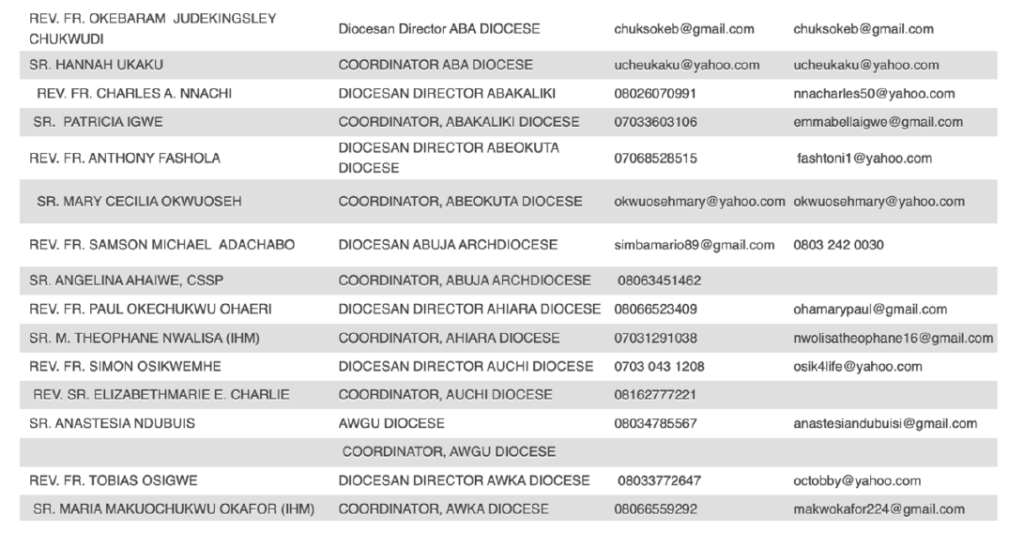
DIOC Directors
ORGANOGRAM
PMS Organization Nigeria
The First Step of the organization centres in the parish. Each parish has a PMS Committee whose work is to coordinate all the PMS activities in the Parish. From there, it steps down to stations and wards where similar committees function, according to the need of each area. For the Holy Childhood, it moves into schools, giving every child the opportunity to participate in the school-based HCA.
The Second Step is the Diocesan level. Here, it is headed by a diocesan director appointed by the diocesan Bishop. The Director works with a Council and may establish committees at the Zonal or Deanery levels for more effective animation and coordination.
The Third Step is the provincial level. Each of the nine Ecclesiastical Provinces in Nigeria has a provincial PMS Council made up of the Diocesan Directors and a few others.
At The National Level, it is headed by the National Director appointed by Rome on the recommendation of the Catholic Bishops Conference of Nigeria. He works with the PMS National Council made up of all the Diocesan Directors and Secretaries of the four arms of the PMS. In addition, each of the four arms of the PMS has a working committee headed by the secretary of that society. The Holy Childhood has the meeting of all diocesan coordinators which assists the Secretary and the Director in the planning and execution of the HCA programmes.
The PMS work in close collaboration with the National Missionary Council of Nigeria, of the Department of Mission and Dialogue (CSN), Catholic Bishops Conference of Nigeria (CBCN). The Bishop Chairman of this Department is the “eye” of the CBCN at the PMS.
At The International Level, the PMS is directly under the congregation of the evangelization of peoples, It is the congregation that appoints the National Director for each countryu. The National Director is a member of the Superior Council of the PMS which meets every year in the month of May in Rome.
About PMS
The exact date to which the birth of the Pontifical Mission Societies in Nigeria could be pinned is not known. But one can deduce that it started with the arrival of the early Missionaries in what is today known as Nigeria. It is common knowledge in the history of the Catholic Church in Nigeria that the Congregation for the Propagation of the Faith (Propaganda Fide), under which the four Pontifical Mission Societies function, was solidly behind the activities of the early missionaries in Nigeria. During those early years of evangelization, missionaries were sustained with funds coming from the Pontifical Mission Societies. However, these Societies were not distinctively known as such in Nigeria. With the setting up of the Catholic Bishops Conference of Nigeria and consequently, the Catholic Secretariat of Nigeria things began to take shape. Whosoever was made the Secretary General of the Secretariat, also handled the affairs of the Pontifical Mission Societies.
The PMS Under Msgr. John Ogbonna (1985-1987)
The first National Director for the Pontifical Mission Societies in Nigeria was Msgr. John Ogbonna. He was appointed as he was ending his last tenure as the Secretary General of the Catholic Secretariat of Nigeria in 1985. Hhe tried to set up the first National Office of the PMS in Abuja. He arrived Abuja in October 1985 and was given a temporary accommodation at the National Missionary Seminary of St. Paul, Gwagwalada, Abuja Federal Capital Territory. From his first record of the Mission Sunday collections of 1985, 19 Dioceses remitted their contributions totalling N44,644.51k. From this humble beginning, by 1986, Msgr Ogbonna was able to get some Dioceses in Nigeria to appoint PMS Diocesan Directors with whom he worked. It was during his tenure as the National Director, that the dates for the celebration of the various arms of the Pontifical Mission Societies were selected and approved by the Catholic Bishops Conference of Nigeria.
- Pontifical Society for the Propagation of the Faith - the usual World Mission Sunday in October. • Pontifical Society of St. Peter Apostle - the Good Shepherd Sunday which is the 4th Sunday of Easter. • Pontifical Missionary Childhood, on Epiphany, though some Dioceses wanted it on the second Sunday of January. • Pontifical Missionary Union of Clergy and Religious, June: Feast of the Sacred Heart of Jesus. The PMS in Nigeria has maintained these dates to this day except for the Holy Childhood which was moved to the Sunday nearest to 2nd February.
The PMS Under Msgr. Benard Okodua (1988-1999)
In 1988, Msgr. Bernard Okodua was appointed to replace the Late Msgr. Joseph Ogbonna. He became the second PMS National Director in Nigeria. With the Catholic Secretariat still in Lagos, and Msgr. Okodua having major diocesan assignments, it became convenient for him to operate from his Diocese and residence in Lagos while maintaining a small PMS office at the Catholic Secretariat of Nigeria, there in Lagos. Msgr. Okodua kept to the tradition of holding two National meetings of the Diocesan Directors. The poor attendance of the Directors did not deter him from his resolve. Rather it spurred him to decide to go to each individual Diocese to meet the Priests and possibly the laity, to enlighten them on the importance of PMS. By the end of
1989, he had covered the Dioceses within Lagos Ecclesiastical Province and embarked on visiting Kaduna province. He had posters printed on PMS and sent to all the Dioceses along with a short essay on the PMS to educate the people. To raise funds for the PMS, he sent out appeal letters, which, however, did not yield much.
Msgr. Okodua worked gallantly for the growth of the Pontifical Mission Societies in spite of difficulties that surrounded him for eleven good years when he finally handed over to Msgr. Hypolite A. Adigwe.
The Period 1999 Msgr. Hypolite A. Adigwe
Msgr. Hypolite Adigwe was appointed to take over from Msgr. Bernard Okodua in 1999. The letter of appointment came with an invitation to attend the meeting of the Superior Council of the PMS in May 1999. As soon as he came back from that meeting, he drew up his plan of action which he presented to the Catholic Bishops Conference. Part of this plan was the restructuring of the PMS. This meant - The Appointment of Acting Secretaries for the Societies • Formation of a National Executive Committee • Formation of Provincial or Regional Councils • Diocesan Councils • Parish Committees
As at then, the PMS National Secretariat was operating as a "One man Secretariat", from the one room office available at the Catholic Secretariat of Nigeria, Lagos. It was obvious that he could not run the National Office in Lagos from the Archdiocese of Onitsha where he was residing. Consequently, the Catholic Bishops Conference of Nigeria took a decision and communicated to him that at the time being his office would be located at Nnewi pending the movement of the National office to Abuja as the entire Catholic Secretariat was moving down to Abuja.
For proper take off of the office at Nnewi, approval was given for a skeletal staff and the transfer of the most necessary documents from the Catholic Secretariat of Nigeria, Lagos to the PMS office at Nnewi.
The first major task which the new Director had set before the National office at this stage was an increased awareness of the people of their responsibilities for the Missionary Apostolate of the Church. He urged Bishops to appoint PMS Diocesan Directors. He also encouraged the formation of PMS Provincial, Diocesan, Parish and Station Councils/Committees.
In October 2000, the Pontifical Mission Societies in Nigeria participated very actively in the World Mission Congress held in Rome with a delegation 20 Diocesan Directors.
National Office Moves To Abuja
By now, the dream of establishing a permanent home for the Pontifical Mission Societies in Nigeria was beginning to take shape in the mind of Msgr. Adigwe.
At the CBCN meeting held in March 2001, the Bishops decided to make a portion of land available from the Abuja Catholic Secretariat grounds for the PMS National Headquarters. The National Director was mandated to source for funds to set up the necessary structure. With the plan of the house approved, work was started with the N21,040,000 granted by the Pontifical Mission Society of the Propagation of the Faith, by Architect Moses Ajah and his company, Cute Arc Project.
There were donations from Dioceses and Religious Institutes and individuals. At last the building was completed. The National Director with the entire Staff of the National Office moved down to Abuja. It was officially blessed in a special ceremony by the Papal Nuncio, Archbishop Renzo Fratini and officially opened by Archbishop Felix Alaba Job, President of the Catholic Bishop Conference of Nigeria on October 11, 2006, in the company of Most Rev. Dr. Hilary Odili Okeke of Nnewi Diocese who had hosted the National Office till then, Most Rev. Dr. Mathew Man-Oso Ndagoso, Bishop of Maiduguri and Bishop Chairman of the Department of Mission and Dialogue of the Catholic Secretariat of Nigeria, and all the PMS Diocesan Directors, many Religious and Lay People.
And Today There Are: - Diocesan Director for every Diocese • Over 2000 animators trained in the School of Missionary Animators (SOMA) for the HCA nationwide • HCA Coordinators in almost all the Dioceses • Thousands of our HCA children "passing out" every year on reaching the age of 14. • Functional Diocesan Councils and Parish/Station Committees • Mission Clubs in Seminaries and Houses of Formation for the Religious • Over 2000 Bishops, Priests and Religious as members of the PMU • General awareness of the PMS among the people of God created by these organs and the numerous • publications of the National Office. • Young Missionary Movement of Nigeria (YOMM) • Missionary Movements for Adults, Families and the Sick! Aged in the offing. • Various formation courses for Missionary ad extra and ad intra.
PONTIFICIAL MISSION SOCIETY
Unlike the other Societies, the Missionary Union of the Clergy has as its immediate and specific purpose the promotion of missionary work and the spread of the missions, not through aid, but through the direct commitment of those who, like the apostles, have received the command: Go, therefore, make disciples of all nations; baptize them in the name of the Father and of the Son and of the Holy Spirit. . ." (Mt 28:19) The Union was founded by Blessed Father Paolo Manna and recognized by Pope Benedict XV on 31 October 1916. In his Apostolic Letter Graves et Increscentes, on the 50th anniversary of the Foundation of the PMU, Pope Paul VI declares that "Just as Christ should be called the First Missionary, so all Priests, in virtue of the Sacred Order they have received, should be considered as missionaries". A statement that affirms an indispensable doctrine and an ever more imperative duty, also through the numerous ecclesial documents that declare this: (Evangelii Nuntiandi 68; Postquam Apostoli 5; Redemptoris Missio 67).
In the same Letter Paul VI defined the Pontifical Missionary Union (PMU) as "the soul of the other Mission Aid Societies". Paolo Manna was born in Avellino (Italy) on 16 January 1872 and, after becoming a missionary of the Pontifical Foreign Mission Institute (PIME), he is sent to Burma. In 12 years of missionary activity he would return to Italy three times on serious medical grounds, the last time, to his great sorrow, to remain there. Thus he discovers God's will for him: to make him, through his writings and publications, a missionary animator of the whole Church: the missionary of the Mission. The aim of his work is not only to announce the progress of faith in the world and to help missionaries with prayers and offerings, but above all to make known the duty to enlarge the Church with more missionaries and with the indigenous clergy, so that she will be able to carry out her work to the full. As director of the magazine Le Missioni Cattolice and particularly with his first work Missionari autem pauci (The Missionaries are Few), he arouses an irresistible surge of enthusiasm for the Mission and a large number of missionary vocations: thus he begins his great task of animating all the clergy for the missions.
His dream of founding a Missionary Union of the Clergy is realized with the approval of Pope Benedict XV, urgently entreated by Blessed Guido Maria Conforti, Bishop of Parma and founder of the Xaverian Missionary Fathers. The Union's First International Congress (3 January 1922)
declares the necessity of missiology teaching in seminaries, a science that was still unknown in Catholic formation institutes.
In order to encourage many vocations for the missions, in his increasingly numerous writings Fr. Manna insists on the irreplaceable role of priests in the proclamation of the Gospel and in the formation of the missionary awareness of the people of God. The Union spreads rapidly after the Pope recommends its presence in every diocese in his EncyclicalMaximum Illud (1919). With a great activity of preaching and publications, Fr. Manna inflames ecclesiastics and laity alike with the missionary ideal, while he challenges young people to realize this ideal. For him there is no such thing as a missionary vocation distinct from the priestly or Christian vocation: his motto is "All Missionaries!" For Fr. Manna all the baptized, but above all every priest is by his very nature and by definition missionary". He complains that for a great part of the clergy "a great elementary truth" has been obscured, "namely, that the primary function of Church is the evangelization of the world - the whole world".
This universal missionary spirit must be integrated into the spirit of unity with those whom he first calls our "Separated Brethren ", "an essential condition for the total triumph of the Gospel in the world". With his studies and dynamic affirmations Blessed Fr. Manna prophetically precedes the declarations of the Second Vatican Council, particularly Ad Gentes 2, 39, Lumen Gentium 28, Optatam Totius 20 and Presbyterorum Ordinis 10. Together with Priests also Religious men and women, as well as Consecreted Laity are natural mission workers. In 1949, with the decree Huic Sacro, the Congregation de Propaganda Fide offers these too membership in the Union. With the decree of 28 October, 1956 Puis XII confers the title on the Union, and it is therefore renamed the "Pontifical Missionary Union of the Clergy, Religious and Consecrated Laity". More simply, it is known as the "Pontifical Missionary Union" (PMU).
Fr. Manna also served his Institute from 1924 to 1934 as Superior General. The fruit of this commitment are hisObservations on the Modern Method of Evangelization in which he proposes a special and different formation for a greater number of indigenous seminarians and the constitution of local Churches entrusted to the local clergy. In his later years, as in a dream, he outlines his great, prophetic and far-reaching missionary plan: Our "Churches" and the Propagation of the Gospel. On the eve of the Second Vatican Council, he invites the older Churches to establish missionary seminaries so that they may participate directly in the evangelization of the world and give help to young mission Churches. Father Paolo Manna dies on 15 September 1952 and is declared Blessed by John Paul II on 4 November 2001.
AIMS
The PMU Strives:
1.
To promote missionary consciousness among seminarians, priests and religious.
2.
To animate all animators of the People of God for the Mission (RM 84) by spreading and promoting the other PMS.
3.
To foster Christian unity so that "they may be so perfected in unity that the world will recognize that it was you who sent me…" (In 17:23).
4.
To put all the Church "in a state of mission".
Material
1.
Meditate on Sacred Scripture in order to understand God's universal plan of salvation and the missionary nature of his Church.
2.
Read and study the documents of the Second Vatican Council and the Popes' missionary Encyclicals.
3.
See one's own history and the history of one's Church in a worldwide perspective, in order to think and act on a worldwide level.
4.
Ask the "Lord of the harvest to send out labourers to his harvest" (Mt. 9:37-38).
5.
Celebrate the Missionary feasts: Lent of prayer and solidarity; missionary October with WMS; St Francis Xavier, Priests' and Brothers' Mission Day; St Teresa of the Child Jesus, Sisters' Mission Day; World Day of the Sick, Week of Prayer for Christian Unity.
Material
1.
Subscribe to national missionary publications and obtain books of Missiology or books that deal with the world's problems for a profound knowledge of Mission and the reality of Religions and Peoples, necessary in a globalised world.
2.
Make an annual contribution to the PMU for its animation activities.
3.
Collaborate with the National Director of the PMS, his Secretary for the PMU and the Diocesan Director, in the organization and activity of missionary animation through the PMU.
4.
Publicise the official publications of the PMU International Office: Omnis Terra (in Italian, English, French, Spanish and Portuguese) and the Course: Studies for Mission (in Italian, English, French and Spanish).
ST. PETER APOSTLE
The charismatic and significantly lay nature of the PMS is clearly seen in the foundation of the Society of St Peter Apostle. In fact this society was born in France on the suggestion of the Vicar Apostolic of Nagasaki, Mgr. Cousin of the Paris Missions Etrangères (MEP), who was convinced of the necessity of a local Clergy, that is, of priests who at that time were known as "indigenous Priests". Therefore this Society is particularly concerned with one of the most urgent necessities for the progress of evangelization: the education and formation of local Clergy through the construction and maintenance of seminaries in Mission lands.
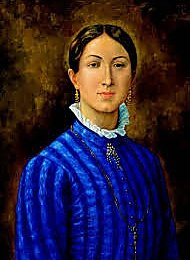
To accomplish his plan to have a seminary in Japan for the spiritual and theological formation of Japanese Priests, Mgr. Cousin turns to a young lay woman Jeanne Bigard. Born in Normandy of a well-to-do family on 8 December 1859, Jeanne acquires from her mother Stephanie a profound interest in spiritual life and as a result develops a strong feeling for the needs of Gospel workers and particularly for missionary priests. Despite her shyness and delicate health, she would become deeply involved in this ideal which became the purpose of her whole life. For this reason she would visit all the dioceses of France and travel abroad as far as Rome.
After giving a large financial contribution to build the church of St Francis Xavier in Kyoto, on her father's death Jeanne sells everything and goes with her mother to live in two shabby rooms so that they can give everything they have to the missions. She keeps up a regular correspondence with missionaries and answers Mgr. Cousin's request promptly, devoting all her energies to collecting the funds necessary for his Japanese seminary. Jeanne used to say she was "pigheaded" on account of her tenacity in doing things, but soon her projects become so numerous and some last so long that she understands that without an organization she cannot perform her task of supporting the Missions. So between 1889 and 1896 she founds an Association that will later become the Society of St Peter Apostle. 1894 Jeanne Bigard publishes her first Manifesto addressed to all Christians in order to draw their attention to the importance of this work for the growth of the Catholic Missions. The Association's first Council of Administration meets and the first propaganda leaflet is published in 1896.
The official date of the Foundation of the Society of St Peter Apostle is 1889 in Caen, France. In 1901 the central office is moved to Paris and later to Fribourg in Switzerland to facilitate its civil recognition and to have a more autonomous administration of its funds. In 1920 its main office is moved to Rome. With the Encyclical Letter Ad extremas Orientis Leo XIII recommends the Work to all Christians and on 3 May 1922 Pius XI declares the Society of St Peter Apostle together with the previous two Societies. After the death of her mother Stephanie, on 5 January 1903, Jeanne falls into a state of deep depression which will transform her life into a painful Calvary. Aware of her situation, she entrusts the Society to the Franciscan Missionaries of Mary in Fribourg. After being admitted several times to various hospitals and a deterioration of her state of mental health, Jeanne is taken to the sisters of St. Joseph in Alencon where she dies on 18 April 1934.
Jeanne Bigard will bequeath to the Church a keen awareness of the worldwide dimension of the missionary task, a clear consciousness of the importance of the local Clergy with a prophetic
vision for the spiritual and human mobilization of the older Churches, with a view to solidarity with the young Churches: seeds of a missionary springtime that would blossom in all members of the Church in Mission.
The significance of her Work can be found in the words of St Paul: "How can they believe in him if they have never heard of him?" (Rom 10:14-15) The increase of indigenous Clergy finds its justification and necessity in Jesus' words: "As the Father sent me, so am I sending you" (Jn 20:21). In fact, as well as being based on the need for Gospel workers, the proclamation of the Gospel must also be based on the culture, religion, life and social organization of every people. All this is best known and used by the sons and daughters of this people, the native Clergy in their local Churches.
AIMS
1.
Insistent recommendation on the Formation and Education of local Priests and Religious.
2.
Contribution with prayer and economic aid to the growth of the local Clergy and of local Religious Communities.
3.
Particular concern for the missionary formation of young people, with a view to increasing the number of vocations to priestly and religious life particularly in the Missions.
4.
Greater involvement of the Catholic Laity, not only with the contribution of aid, but also through their personal commitment of missionary activity.
Recognized by the Church for its service to Mission, the POF has not only the title "Pontifical", but also "Episcopal". It is part of the Universal Church that co-ordinates missionary activity throughout the world, but it is also part of the Local Church that has the right and duty to "make disciples of all nations" (Mt. 28:19). In fact for all the Pontifical Missionary Societies it is profoundly true that: "although they are the Pope's Works, they are also the Works of the entire Episcopate and of the whole People of God" (Paul VI, Message WMS 1968).
Spiritual
1.
Pray unceasingly for missionary priestly vocations in accordance with Jesus' command: "Ask the Lord of the harvest to send out labourers to his harvest" (Mt. 9:38).
2.
Establish a spiritual chain of friendship, interest and sharing in apostolic life through letters, visits and contacts of various kinds between Churches' various education and formation centres.
3.
Welcome members of other Dioceses and religious Congregations with Christian fellowship and joy into one's own Institutions in order to offer them a spiritual environment where they can emulate one another in holiness in God's service.
Material
1.
Make a financial contribution to the expansion of Seminaries and Houses of religious formation in Mission Churches.
2.
Celebrate Vocation Sunday (generally celebrated on the 4th Sunday of Easter, Good Shepherd Sunday) with prayer, spiritual activities and a special offering for Seminaries.
3.
Provide "Scholarship" for individual seminarians' material and educational needs in Mission Seminaries.
4.
Adopt candidates to the priesthood, both with personal and group contributions, in order to accompany them towards the goal of Priesthood.
5.
On a level of ecclesial organizations undertake to build or maintain new seminaries in Mission territories.